

Monthly Power Electronics Intelligence
V2G Technology Deep-Dive + India Policy Update
January 2025 — V2G Technology Deep-Dive + India Policy Update
Edrift Engineering Team
Power Electronics Intelligence
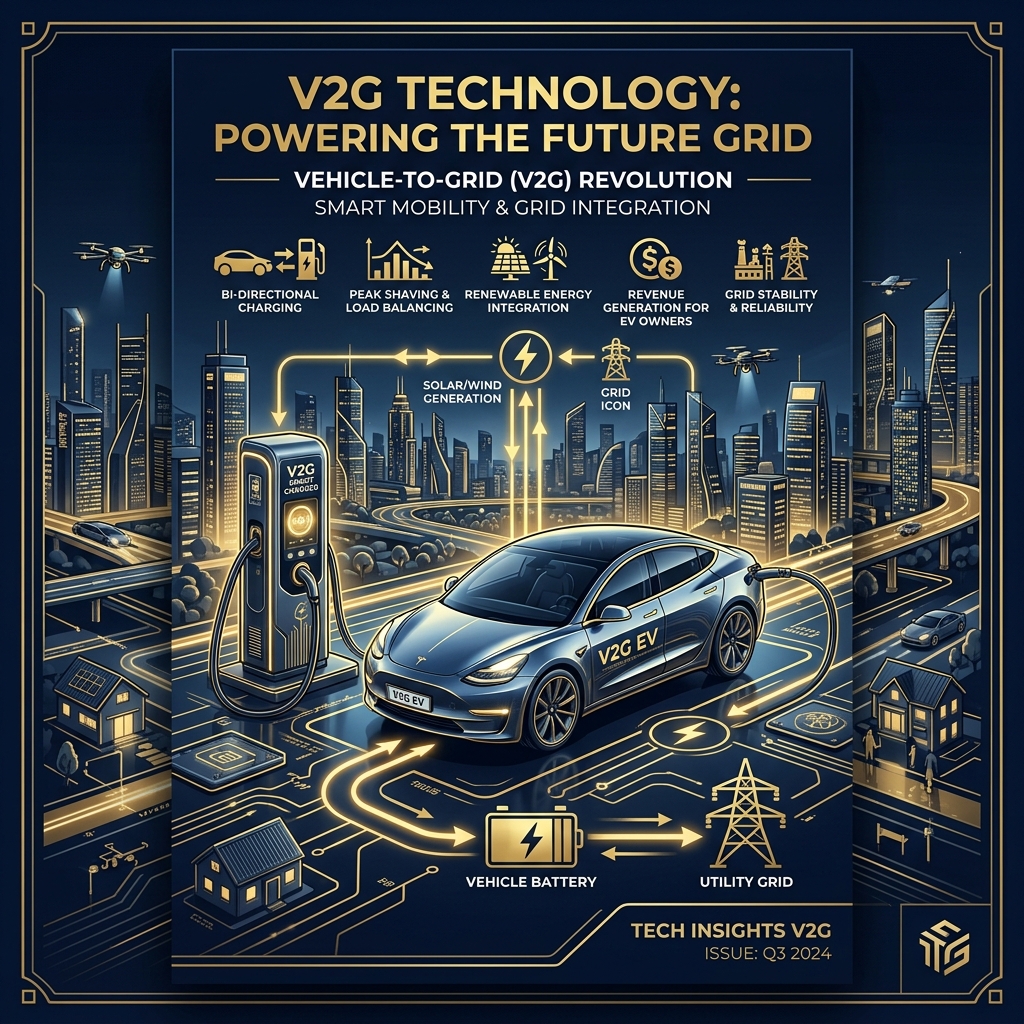
FEATURED DEEP-DIVE — V2G & V2H TECHNOLOGY EXPLAINED
WHAT IS V2G AND V2H?
V2G (Vehicle-to-Grid): The ability of an electric vehicle to discharge stored energy from its battery back to the electrical grid. This enables the EV to act as a distributed energy storage resource, providing grid stabilization services and earning revenue for the vehicle owner during peak demand periods.
V2H (Vehicle-to-Home): The ability of an EV to power a home during a grid outage or during peak tariff hours. The vehicle battery becomes a home energy backup system — particularly valuable in India where grid reliability varies significantly by region.
V2L (Vehicle-to-Load): General ability to power external loads (tools, appliances, camping equipment) from the vehicle battery via a standard AC outlet built into the vehicle.
WHY IS THIS HARD TO ENGINEER?
A conventional on-board charger (OBC) is a unidirectional power converter: AC Grid → Rectifier → PFC → Isolated DC-DC → Battery (charging)
A bidirectional OBC must enable: AC Grid ⇄ Rectifier/Inverter ⇄ Isolated DC-DC ⇄ Battery
This requires:
SEMICONDUCTOR SELECTION FOR BIDIRECTIONAL CHARGERS
For bidirectional operation, the body diode of the switching device conducts during dead-time transitions in every switching cycle. IGBT body diodes have high reverse recovery charge (Qrr), making them unsuitable for efficient bidirectional designs above 50 kHz.
SiC MOSFETs have near-zero reverse recovery (Qrr ≈ 0), making them the strongly preferred semiconductor for bidirectional EV chargers operating at 100+ kHz.
MARKET STATUS — V2G/V2H IN INDIA (2025)
Technical maturity: High. Standards exist (ISO 15118-20), SiC devices are mature. Vehicle support: Low but growing. MG ZS EV, BYD Atto 3, and upcoming Tata/Mahindra models. Grid integration: Very low. DISCOMs have no established framework for revenue settlement or interconnection standards.
Edrift's assessment: V2H will arrive in India before V2G because it does not require DISCOM coordination.
---
TOOL LAUNCH — GaN TOTEM-POLE PFC DESIGN CALCULATOR
The totem-pole Power Factor Correction (PFC) topology is becoming the dominant AC-DC stage in high-efficiency EV chargers. It eliminates the diode bridge rectifier — removing 15–25W of conduction loss in a typical 3.3 kW charger design.
This calculator automates the design process:
[Try the GaN Totem-Pole PFC Calculator →](/engineering-tools/gan-totem-pole-pfc-calculator)
---
INDIA POLICY UPDATE — FAME III DRAFT GUIDELINES ANALYSIS
The Ministry of Heavy Industries (MHI) released the draft guidelines for FAME III in late December 2024.
Key Changes vs FAME II:
---
TECHNICAL DEEP-DIVE — BIDIRECTIONAL CONTROL COMPLEXITY
CHALLENGE: MODE TRANSITION WITHOUT TRANSIENTS
When transitioning from charge mode to discharge mode, the DC bus voltage must be maintained without interruption. Edrift uses dual-loop control with feed-forward compensation to handle handoffs in < 50 ms.
CHALLENGE: ANTI-ISLANDING DETECTION
The charger must detect grid disconnection within 2 seconds and stop inverting. Edrift implements a hybrid passive + active detection method with a shutdown time of < 200 ms.
---
WE ARE HIRING — OPEN ENGINEERING POSITIONS
Edrift Electric is growing. We are looking for exceptional engineers in:
[View All Open Positions →](/careers)